

Government's Northern Endeavour oil vessel cleanup set to exceed $2b
Woodside sold the project to an insubstantial company to avoid a few hundred million in decommissioning costs: now it and its competitors will pay the price.
Woodside sold the project to an insubstantial company to avoid a few hundred million in decommissioning costs: now it and its competitors will pay the price.

The US-owned company is seeking funds from investors to stay a going concern while it awaits state and Federal approval.
WA Premier Mark McGowan warned Alcoa to lift its game or face curtailed mining, but his successor Roger Cook slashed water supply protections after a possibly empty threat from the US miner.
The half-sized project in WA's North West will now pursue power sales to Pilbara miners and data centres and the production of green ammonia off-site.

The size of Australia's largest renewable energy project has been cut by nearly half, and the remote Pilbara site will no longer produce ammonia from green hydrogen.
The Australian Renewable Energy Hub was to incorporate 26 gigawatts of wind and solar power generation over 6,500 square kilometres of WA's North West to make 10 million tonnes of green ammonia a year, at a cost of about $50 billion.
On Wednesday, WA's environmental watchdog, the EPA, posted that it had terminated its assessment of the project at the request of the proponent InterContinental Energy (ICE).
An ICE spokeswoman said the project's initial phases would continue under an earlier approval for a 15-gigawatt power project, and it may seek approval for a future expansion.
She said the now-dumped referral "proposed a number of additional elements, including desalination and green hydrogen and ammonia production infrastructure, alternative export arrangements, an expanded solar footprint and a company town."
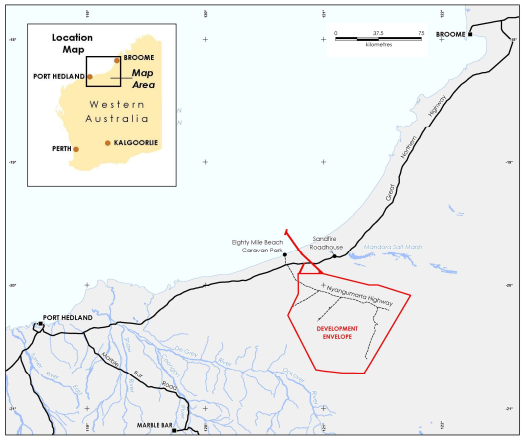
"ICE has requested termination of that unassessed referral as an administrative clean-up, as no assessment of those proposed revisions is being progressed under that referral," she said.
ICE lodged its earlier 15-gigawatt plan with the EPA in 2018, and the WA Government approved it in 2020. It envisaged exporting power to Indonesia and Singapore via a subsea cable, but dropped that option some years ago.
For over a decade, ICE has sought ways to monetise its exclusive rights to develop renewable energy in the project area (see timeline below).
In that time, blue-chip partners Vestas, Macquarie and BP have come and gone, and early investor CWP Global exited in 2025.
The initial concept to power South East Asia was replaced by making ammonia from green hydrogen at the remote site and loading it onto ships through a purpose-built marine facility.
 Peter Milne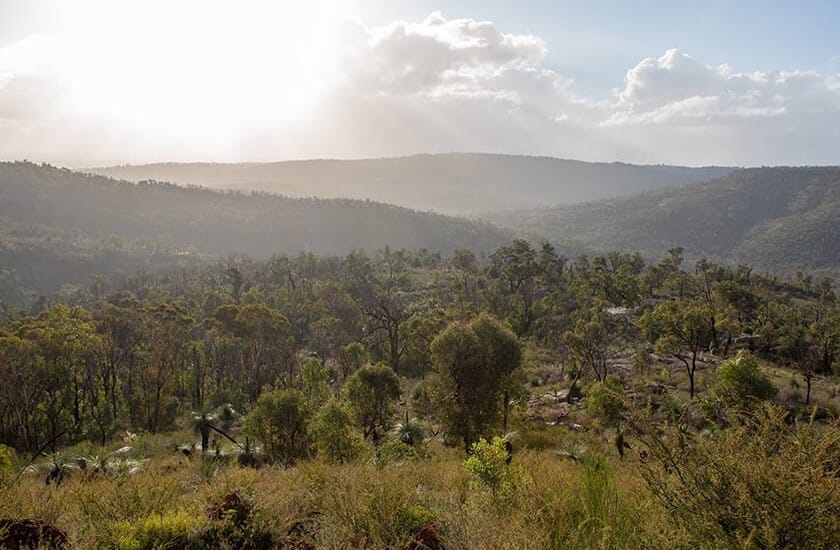
The company spokeswoman said the project strategy subsequently evolved toward supplying renewable electricity and hydrogen to support industry in the Pilbara, including green iron, mining decarbonisation and critical minerals processing.
In 2023, AREH was allocated land at the Boodarie Strategic Industrial Area near Port Hedland "with a plan to supply renewable power and green hydrogen to miners and industrial users in the Pilbara, and for export to major international markets."
To succeed, the project needs the Pilbara Green Link to connect AREH and the Pilbara power network with 550km of high-voltage 330kV transmission lines.
The news of AREH being downsized comes days after Woodside canned its commitment to invest $US5 billion in clean energy by 2030. The move will further reduce the likelihood of it building its PerthH2 plant to export lower-carbon blue hydrogen.
Woodside did invest $US2.35 billion in the Beaumont blue ammonia project in Texas. However, the future of the investment to produce lower-carbon blue ammonia by using carbon storage is now under review.
In 2025, fellow WA company Fortescue axed two green hydrogen projects and slashed jobs associated with the clean fuel.
In January, the Australian Renewable Energy Agency (ARENA) backed the AREH project with $22 million towards a $95 million study focused on renewable hydrogen production in the Pilbara.
ICE said the study would advance the project's aim to produce large volumes of low-cost green hydrogen to underpin efforts to make green iron in the Pilbara.
An ARENA spokeswoman said the pre-FEED study will assess the technical, commercial, environmental and stakeholder requirements associated with potential renewable hydrogen development at Boodarie to support future green iron production
2014 - Planning begins
2016 - WA Government awards exclusive rights to develop a renewable energy project over a vast area between Port Hedland and Broome.
2017 - InterContinental Energy, CWP and wind turbine manufacturer Vestas launch the Asian Renewable Energy Hub to supply five gigawatts of wind and solar electrical power to Indonesia through subsea cables at a cost of $13 billion. A final investment decision (FID) for the Asian Renewable Energy Hub was planned for 2020.
2018 - Planned capacity increased to 11 gigawatts to provide power to the Pilbara as well as Indonesia. Macquarie joined as an investor at a cost of $22 billion. FID planned for 2021.
May 2020 - WA EPA approves $22 billion plans for 15 gigawatts of generation. FID planned for 2025.
October 2020 - AREH switches to 26 gigawatts of renewable generation to produce 10 million tonnes a year of green ammonia for export at a cost of $50 billion. Project to span 6,500 square kilometres. FID still planned for 2025. Revised proposal submitted to the WA EPA.
2022 - BP buys a 40 per cent stake in AREH and assumes operatorship. Vestas no longer involved. Project renamed the Australian Renewable Energy Hub.
2023 - AREH allocated land at the Boodarie Strategic Industrial Area "with a plan to supply renewable power and green hydrogen to miners and industrial users in the Pilbara, and for export to major international markets."
2024 - Macquarie sells out to BP.
2025 - BP pulls out. CWP Global also exits. ICE back in charge.
January 2026 - ARENA contributes $22 million to investigate hydrogen production.
May 2026 – ICE adds data centres to its plans to use power from the AREH.
August 2026 - ICE stops assessment of 26-gigawatt project, reverts to the 15-gigawatt plan approved in 2020.
UPDATE
27 August 2025 - Following clarification from ICE, added: CWP Global is no longer an investor in AREH; power for data centres is being pursued; ICE may apply for approval to expand to 26 gigawatts in the future; and while ammonia will not be produced on the project site, this could occur at Boodarie.

UK-listed Georgina Energy plans to drill in the remote Little Great Sandy Desert in search of helium, hydrogen and natural gas.

As the world electrifies, demand for the metal is expected to jump 50 per cent in 15 years.

The shutdown of the Yara Pilbara plant comes as a quarter of global trade in ammonia, used for urea fertiliser and mining explosives, is blocked by war.

Canadian firm Vermilion judged the chance of the December spill as "rare" - the same probability it claims for seven planned exploration wells that could affect anywhere along the Pilbara coast.
Every story straight to your inbox and the occasional round up of info and comment.