WA Premier Mark McGowan warned Alcoa to lift its game or face curtailed mining, but his successor Roger Cook slashed water supply protections after a possibly empty threat from the US miner.
WA's south-west power grid shattered numerous records in late 2024 as new batteries and more rooftop solar replaced unavailable coal-fired power.
According to the Australian Energy Market Operator's Quarterly Energy Dynamics report released on Thursday, the state's three coal-fired stations in Collie generated almost 20 per cent less power in the December quarter than 12 months ago because they were increasingly unavailable.
Instead, customers on the South West Interconnected System were served by 20 per cent more output from rooftop solar, a 14 per cent jump in gas-fired generation and a growing contribution from grid-scale batteries.
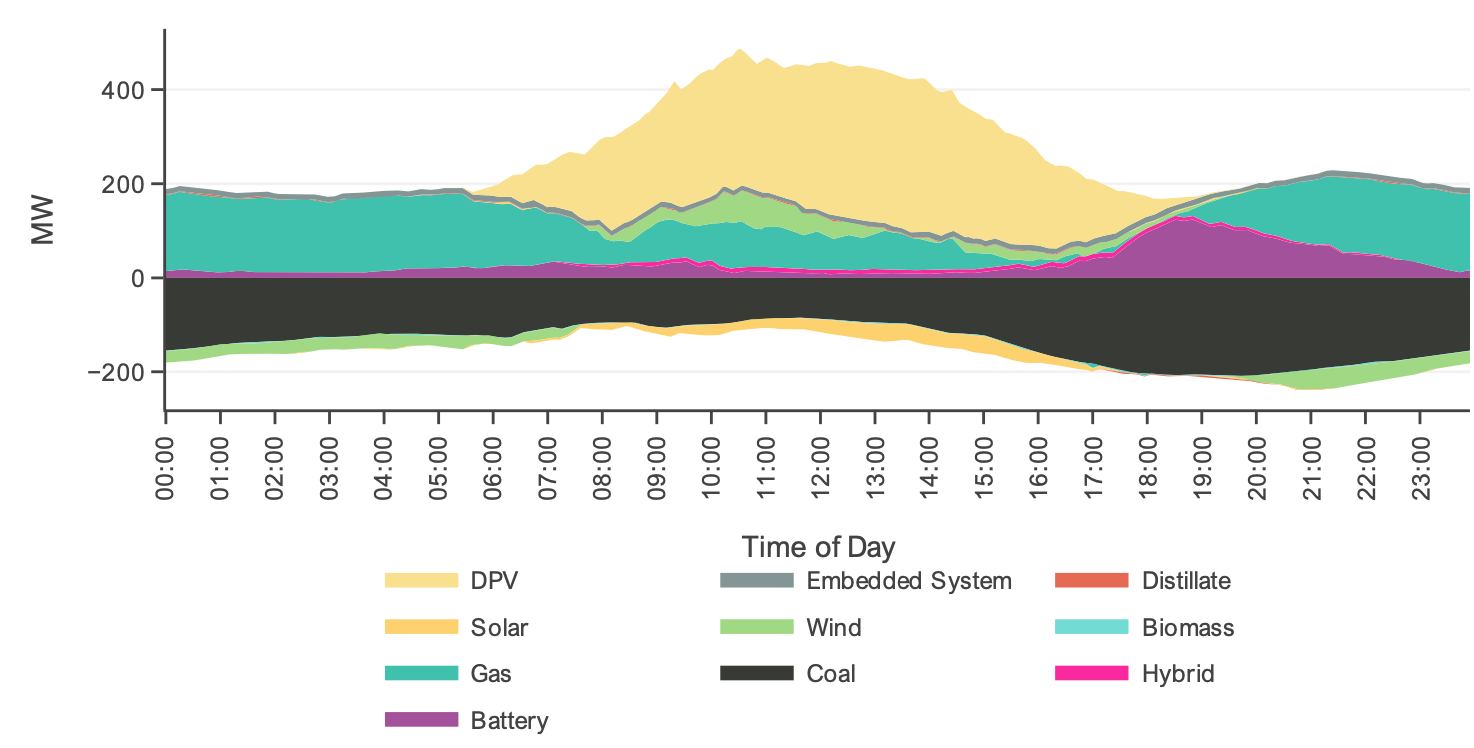
Power source changes for an average December quarter day - 2023 v 2024. Rooftop solar (DPV), gas and batteries are all up. AEMO
The switch from coal cut total greenhouse gas emissions to power the south-west by five per cent despite a four per cent jump in demand for the quarter.
The power system is having to cope with more extreme demands.
On December 11, when Perth was sweltering at 40 degrees, demand hit a record for the December quarter.
Conversely, on November 10, a weekend, mild temperatures negated the need to use air conditioning, and sunny skies boosted rooftop solar output and sent operational demand (everything but non-rooftop solar energy) to a record low.
Over the three months, 46 per cent of power came from renewable generation, and the average wholesale price of $79.93/megawatt was four per cent cheaper than a year ago.
At one time on November 17, renewables supplied 85 per cent of demand.
Batteries now have a significant role, supplying an average of 103 megawatts in the evening from 5:30 PM to 9:00 PM, compared to just six megawatts a year ago.
Without the batteries storing excess solar power during the day, additional coal would have had to be burnt each evening.
The role of batteries will continue to grow, with more than 2000 megawatts of capacity expected to be installed by the end of 2026.
WA's battery charge
Synergy Kwinana - 100 megawatts for two hours - operational
Synergy Kwinana 2 - 200 megawatts for four hours - undergoing operational testing
Synergy Collie - 500 megawatts for four hours - to be completed 2025
Neoen Collie stage 1 - 219 megawatts for four hours - operating since October 2024
Neoen Collie stage 2 - 341 megawatts for four hours - under construction, expected to be operational Q4 2025
Alinta Wagerup - 100 megawatts for two hours - start-up planned for early 2025
I worked in oil & gas in commercial and engineering roles for 20 years. Since 2016, I have written for The West Australian, WAtoday, The Guardian and Boiling Cold, winning five WA Media Awards.
Asia's fossil fuel industry readies to once again talk up carbon capture and storage (CCS) as the technology that lets us keep burning coal and gas, while still hitting our climate targets.
Australia's safeguard mechanism is failing to reduce emissions because major polluters are relying on unlimited carbon offsets, according to The Australia Institute.