

Wandoo oil off WA gives Vermilion a profit-free decade
No profit, falling production, inadequate maintenance, a safety plan in limbo and a big clean-up if exploration fails: challenges aplenty at the Canadian company's only offshore facility.
No profit, falling production, inadequate maintenance, a safety plan in limbo and a big clean-up if exploration fails: challenges aplenty at the Canadian company's only offshore facility.

Santos' decommissioning liability matches a quarter of its $22b value, but its disclosures to investors fared poorly against the latest accounting standards, according to an international survey.
Australia's biggest oil and gas producer has posted record production and cut costs, but weak fossil fuel prices have weighed on profits

No profit, falling production, inadequate maintenance, a safety plan in limbo and a big clean-up if exploration fails: challenges aplenty at the Canadian company's only offshore facility.

Vermilion Energy, slammed by Australia's offshore regulator NOPSEMA for repeated non-compliance with its environmental protection plan, has barely made a profit from its Wandoo oil field off WA over the past decade.
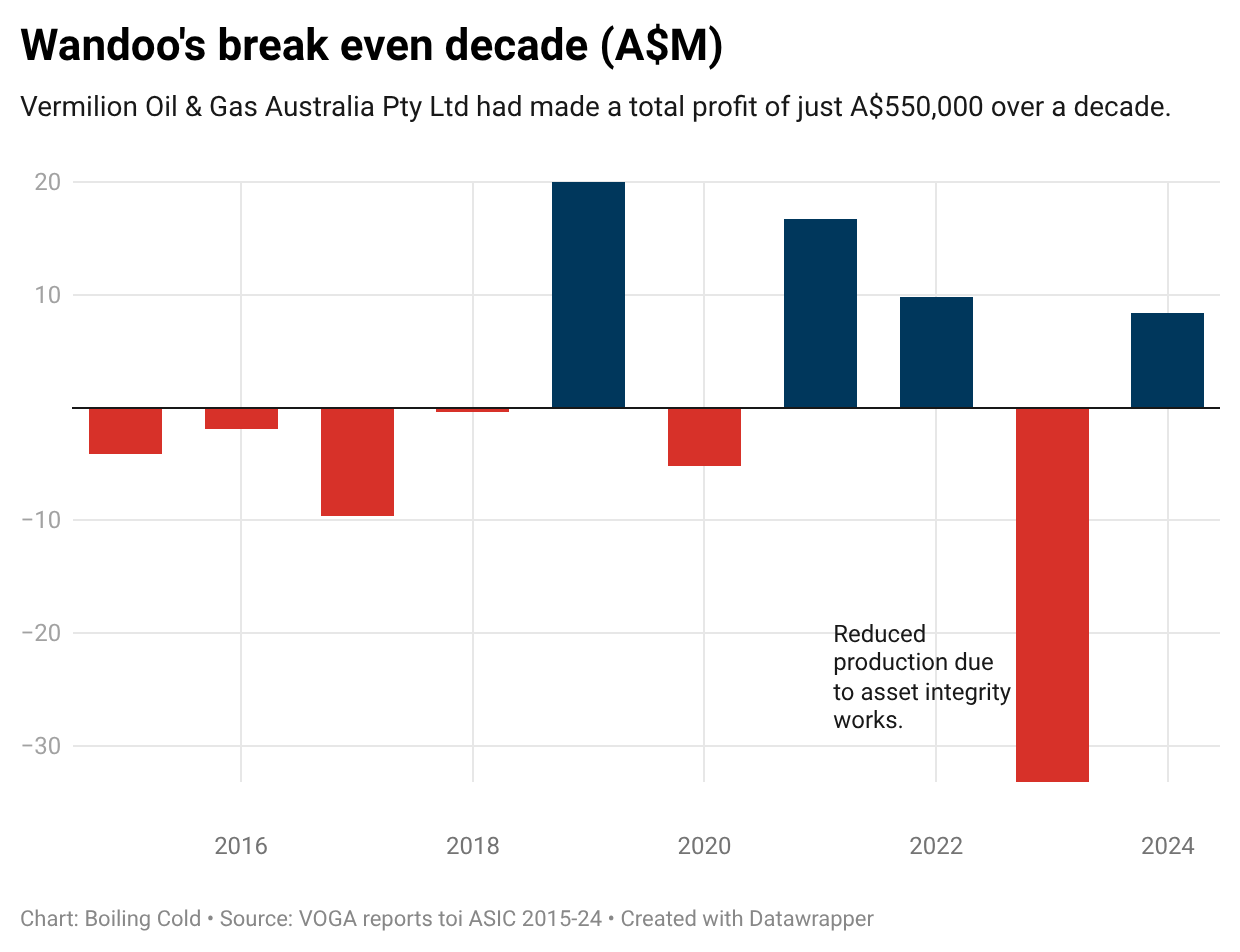
The low-profile Canadian firm's total profit from its only offshore production was just $550,000 over the years 2015 to 2024, according to annual reports filed by its Australian subsidiary with the corporate regulator ASIC. The 2025 report is not yet available.
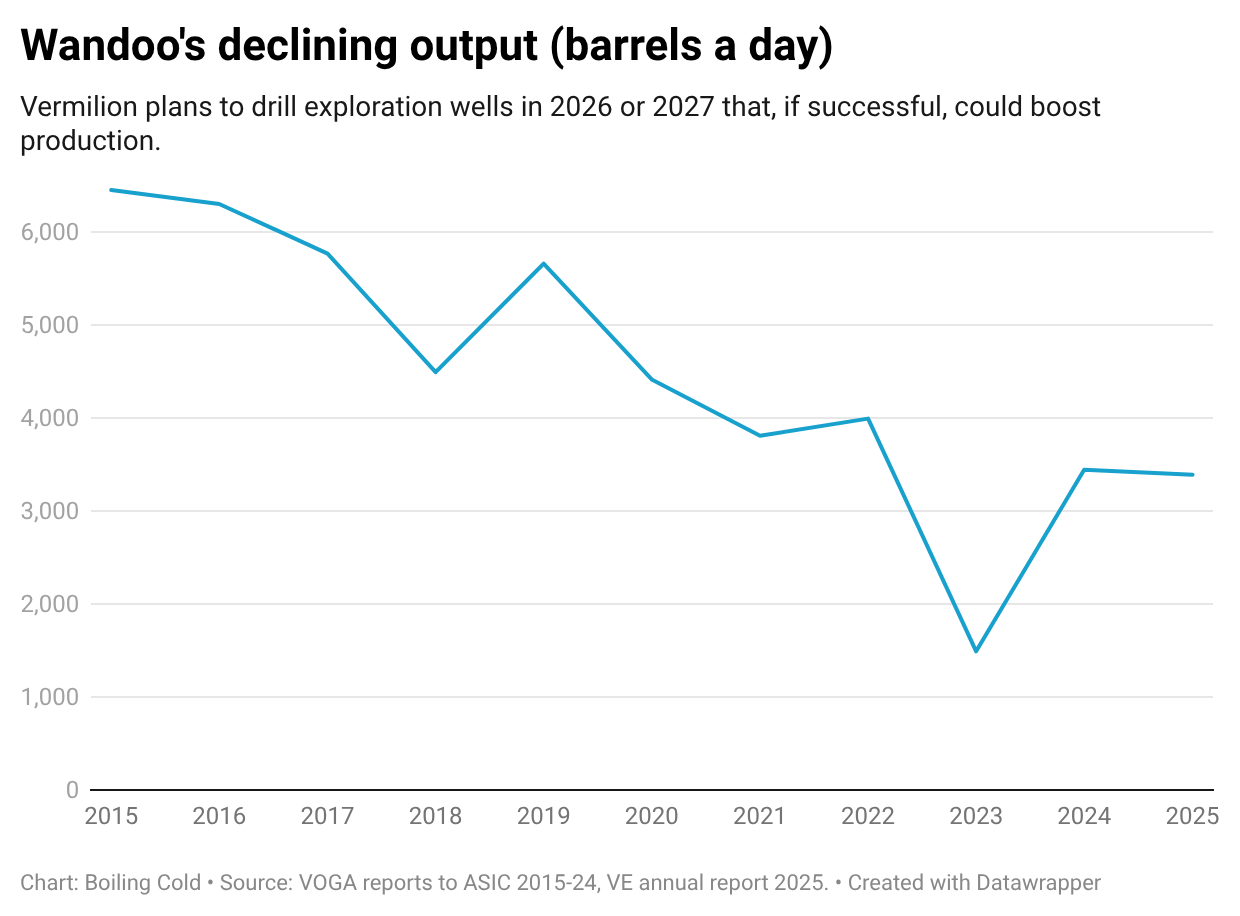
Over that decade, annual production fell 47 per cent, and in 2025 it dipped a further two per cent.
Safety on an oil and gas facility offshore Australia is governed by a safety case document produced by the operator and approved by NOPSEMA.
The focus is on avoiding low probability but high consequence "major accident events" that could kill numerous workers.
Vermilion submitted a required update to its Wandoo safety case in June 2025, according to a NOPSEMA spokesman.
"The revision was not accepted," he said.
"NOPSEMA assesses safety cases and revisions against legislative requirements and will not accept them where those requirements are not met."
Boiling Cold understands Vermilion was told in July what it needed to fix.
Eight months later it has not submitted an improved safety case to the regulators.
A Vermilion spokesman said it originally submitted the safety case just before significant legislative changes.
"Vermilion is now incorporating the relevant updates to its safety case in line with NOPSEMA’s process and expectations and the new legislation," he said.
The legislative changes were published in December 2024, seven months before Vermilion submitted the safety case, and came into effect in June 2025.
In February, the regulator ordered Vermilion to stop loading oil tankers after it found the company had not demonstrated that the Wandoo oil export system was fit for service.
Vermilion has now implemented temporary measures to make the system safe and recommenced export of stored oil on February 27.
However, it has been directed to completely replace the export system by December 2027.
NOPSEMA also had broader concerns about Vermilion's inadequate maintenance and failure to comply with its own plan to protect the environment around Wandoo.
There have been four minor oil spills in the past five years, and it seems Vermilion ignored warnings to shape up.
"These issues reflect recurring themes from earlier inspections and show that corrective actions and assurance processes have not fully addressed the underlying causes," the regulator noted in its direction.
"These matters have been repeatedly communicated to VOGA (Vermilion Oil & Gas Australia)."
 Peter Milne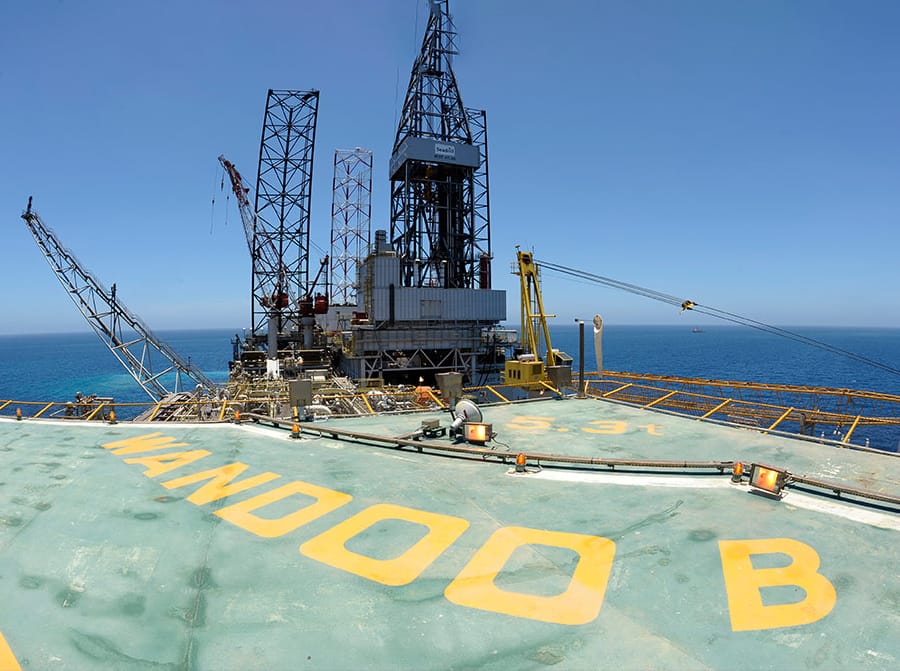
VOGA has until early June to complete an independent third-party review into its management of health, safety and the environment.
Vermilion vice president for international operations and health, saftey and the environment, Darcy Kerwin, told investment analysts last week that the NOPSEMA direction was "kind of a standard regulator response in a situation like that."
Wandoo has not produced oil since the facility was damaged by Cyclone Mitchell on February 7.
Vermilion chief executive Dion Hatcher said the company planned to restart production in the June quarter.
Hatcher was speaking after announcing Vermilion lost $CAD654 million ($689 million) in 2025, its third consecutive year in the red.
Boiling Cold keeps an informed and independent eye on WA's powerful oil and gas sector and is free for all to read, maximising impact and accountability.
I need your backing to keep covering stories that would otherwise go unreported.
Vermilion is preparing to search for more oil to produce from its Wandoo facility.
"Vermilion has every intention of operating the platform to its 2037 end of life," a company spokesman said.
In February, NOPSEMA approved a Vermilion plan to survey the seabed around Wandoo for suitable locations for a drill rig.
Vermilion has a follow-up plan with the regulator for assessment to drill up to seven exploration wells in 2026 or 2027.
If Vermilion does not drill the exploration wells, or if the results are disappointing, it will likely have to decommission the Wandoo facilities earlier than expected.
Vermilion's consultants estimate decommissioning the steel Wandoo A platform, and pipelines will cost $103 million, and abandoning the wells an additional $106 million, according to th VOGA 2024 annual filing to ASIC.
However, Vermilion has assumed it can leave the Wandoo B concrete gravity structure in the ocean forever, and has not allowed for its removal in the asset retirement obligations it discloses to investors.
The massive sub-structure was built in Bunbury with 28,000 cubic metres of concrete and 8500 tonnes of steel and can store 400,000 barrels of oil. Above it is a 6500 tonne steel topsides structure.
The cost to remove Wandoo B, likely many times greater than for Wandoo A, may not be easily avoided under current arrangements.
Santos, Australia's second-largest oil and gas company, is reported to be lobbying the Federal Government to shift from its default position that all equipment is removed from the ocean.
Vermilion slashed the book value of Wandoo by two-thirds to $84 million in its 2025 annual report, released on Thursday, Australian time, which said the price-related impairment was "not an indication of deterioration in the performance or outlook" of Wandoo.
The accounting adjustment was determined before the US and Israeli attack on Iran, and the subsequent closure of the Strait of Hormuz pushed oil prices skywards.

Santos' decommissioning liability matches a quarter of its $22b value, but its disclosures to investors fared poorly against the latest accounting standards, according to an international survey.

Australia's biggest oil and gas producer has posted record production and cut costs, but weak fossil fuel prices have weighed on profits

Canadian firm Vermilion judged the chance of the December spill as "rare" - the same probability it claims for seven planned exploration wells that could affect anywhere along the Pilbara coast.

Chief executive Bill Oplinger told Wall Street the miner had responded to all 60,000 comments on its WA expansion plans—in fact, it responded to fewer than 10, and some were unacceptable.
All the info and a bit of comment on WA energy, industry and climate every Friday