WA Premier Mark McGowan warned Alcoa to lift its game or face curtailed mining, but his successor Roger Cook slashed water supply protections after a possibly empty threat from the US miner.
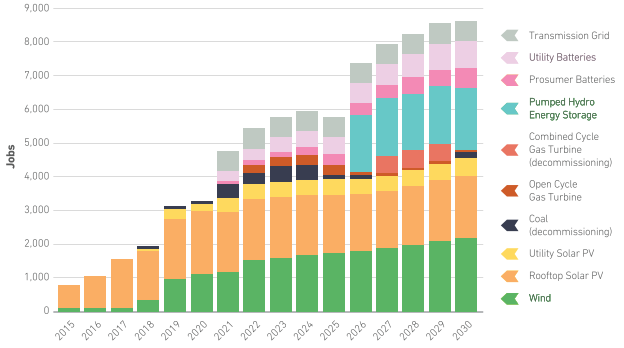
Moving the South West of WA electricity supply to 90% renewable energy by 2030 could create an average of 5000 jobs across the decade, according to a plan by advocacy group Sustainable Energy Now.
The ambitious plan launched by SEN this week was backed by modelling of the South West Interconnected System across the year and an estimate of direct jobs.
The multiplier effect of employment to determine the number of indirect jobs created was conservatively ignored.
The plan did not allow for a significant rise in demand SEN expects from electric vehicles and gas to electricity switching in commercial and industrial applications.
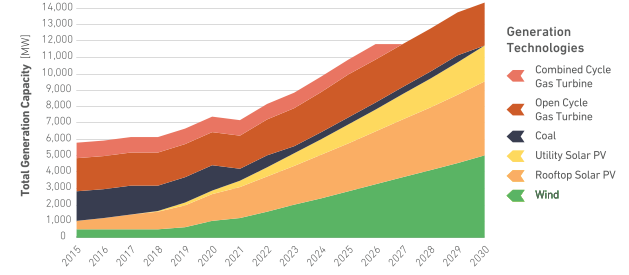
During this decade, wind power capacity is assumed to increase five-fold, solar farms eight-fold and rooftop solar 2.5 times.
To make way for more wind and solar power coal-fired generation is retired by 2030 and combined-cycle gas turbines by 2027.
SWIS generation capacity by technology Source: SEN Report
The total capacity of open-cycle gas turbines increases slightly. They are a large part of the generation capacity by 2030 and serve as so-called peakers - only running when there is insufficient power from wind, solar and storage – to generate the 10% non-renewable component of the power mix.
While coal and combined-cycle gas disappear and other generation grows, the most significant change in the South West to achieve 90% renewable energy is storage.
Utility-scale and household batteries with 3200 megawatt-hours capacity capable of delivering 1200 megawatts are required.
To cover rarer but more extended periods with insufficient wind and solar power, the SWIS will need 8000 megawatt-hours of pumped hydro storage that can deliver 800 megawatts into the grid.
WA is less-suited to pumped-hydro storage that eastern stated due to its flat topography. The Collie coal mines, and the Harvey and Wellington dams are possible sites for pumped-hydro storage are.
The SEN report concluded 90% renewable energy by 2030 is technically possible but acknowledges it may not be realistic from a business perspective.
SEN assumed that a rapid transition to a high penetration of renewable energy was driven by government policy that created a steady flow of work and jobs.
Predicted full time equivalent jobs Source: SEN Report
“In an isolated state like WA, a clear Government timeline for staged renewables rollout would enable commercial enterprises to invest in appropriate and sufficient manufacturing capacity,” the report stated.
The alternative hands-off approach would likely “involve significant delay followed by problematic booms and busts.”
Other roadblocks identified were an overcapacity of fossil fuel generation on the grid and possible constraints on wind farms connecting to Western Power’s transmission system.
Main image: Warradarge wind farm. Source: Bright Energy Investments
I worked in oil & gas in commercial and engineering roles for 20 years. Since 2016, I have written for The West Australian, WAtoday, The Guardian and Boiling Cold, winning five WA Media Awards.
South West WA's power grid reached a record 91 per cent peak renewable energy share in December - driven by 1,225 MW of new battery storage - while wholesale power prices fell 13 per cent and carbon emissions dropped 15 per cent as coal and gas generation declined.
The state-owned utility needs to replace the generation capacity it will lose by closing down all its coal-fired power stations over the next four years.
The operator of South West WA's power grid needs insolvent Griffin Coal to keep supplying a vital power station, but if the WA Government won't keep it going, who will?