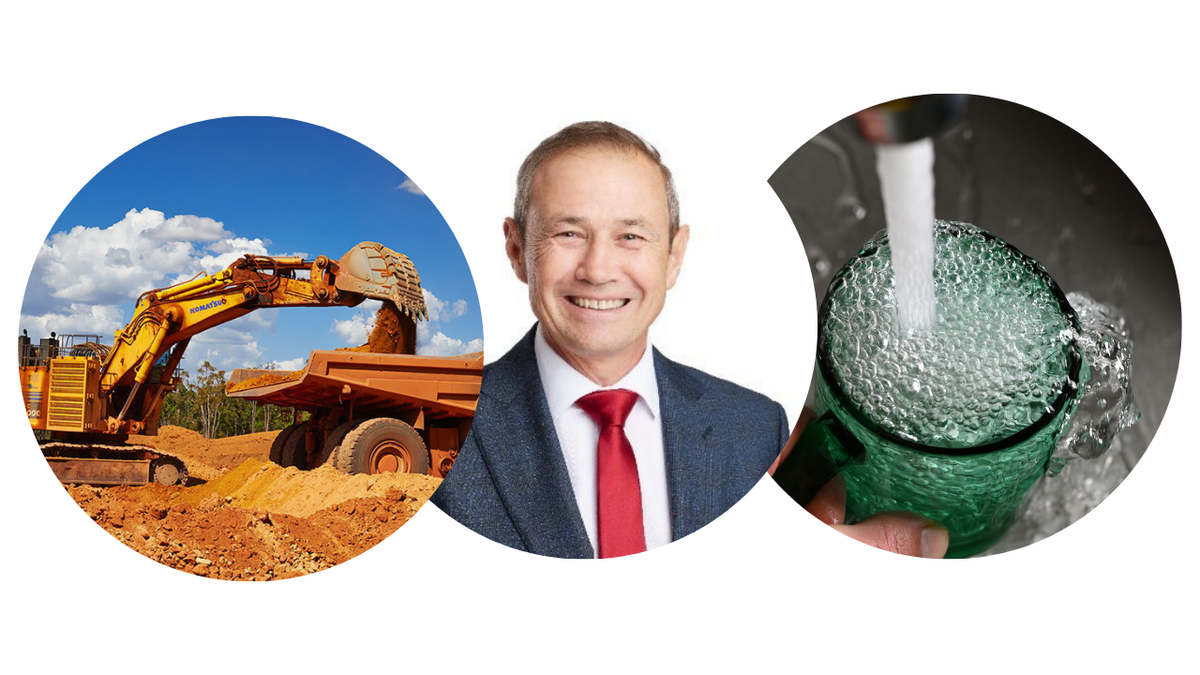
Chief executive Bill Oplinger told Wall Street the miner had responded to all 60,000 comments on its WA expansion plans—in fact, it responded to fewer than 10, and some were unacceptable.
The WA government will soon decide whether Black Mountain Energy can frack 20 wells near the Kimberley's Fitzroy River, but promised measures to protect the environment and the rights of local people are not yet in place.
Alcoa chief executive Bill Oplinger told Wall Street the US aluminium specialist could take strong action to boost profits from alumina, most of which it refines in Western Australia.
WA’s gas giants have not provided evidence that their multi-billion-dollar exports help Asian countries reduce their emissions, according to Chris Tallentire, a Labor MP for 16 years.
Tallentire’s submission to a WA parliamentary inquiry into “the role of Western Australia in the global effort on decarbonisation” refutes the basis of WA Premier Roger Cook’s strong support for gas exports.
“It’s not good enough for claims to be made about Western Australian gas … without any supporting figures,” said Tallentire, who left politics in March.
“Yet, that’s what’s happening, locking us into unleashing mega tonnes of climate-changing emissions.”
Cook has consistently argued that WA’s emissions must continue to rise – unlike every other state – so it can export gas to Asia to displace coal and support renewables, and process minerals critical for the manufacture of renewable energy equipment.
“Put simply, the benefits of WA helping other high-emission countries to decarbonise far outstrips the benefits of decarbonising our own economy,” Cook told an energy conference in late 2023.
“And part of that equation is WA supply of transitional fuels (gas), because the global transition isn't always as simple as quitting fossil fuels and replacing them with renewables.”
Tallentire, in his submission released on Thursday, said he had been prepared to accept this argument, but a lack of evidence made it difficult to address constituents’ concerns about Woodside’s plans to operate its North West Shelf export plant until 2070 and develop the Browse gas field.
“Woodside couldn’t produce the evidence and support its rhetorical claims about decarbonising Asia,” he said.
Australia’s largest oil and gas company had commissioned the CSIRO to investigate the question, but in 2019, Australia’s premier science agency produced the wrong answer: gas was of no help, or even hindered the uptake of renewable energy unless the countries buying Woodside’s gas had a high carbon price. None of them do.
“Woodside hid the CSIRO report and only released it when compelled to do so, claiming it was out-of-date,” Tallentire said.
Woodside went on to commission a report from another consultant that assumed all of its gas would displace other fossil fuels and not compete with renewables, accepting the premise the CSIRO had rejected.
Tallentire said the WA Government commissioned Deloitte when it became clear that neither it nor Woodside had evidence that gas exports reduced global emissions, but the report was being kept secret.
Since his October 10 submission, a draft of the report was leaked to the media, revealing exports of Australian gas carried “substantial risks” of slowing the move to cleaner energy in Asian countries.
Then, on Tuesday, the WA Government tabled a later version of the report in Parliament and was accused of doctoring itto be more supportive of its pro-industry stance.
Tallentire warned the committee to treat submissions from gas producers with caution.
“WA’s gas industry has a shocking record for making claims that later prove to be baseless,” he said.
Tallentire also diverged from his Government’s unwavering support for the resources sector in his farewell speech to Parliament.
“By nearly all measures, we continue to lose nature, yet we see absurd campaigns, especially by Seven West Media and certain interest groups, to weaken environmental laws,” he said.
“There is never any acknowledgement of the gravity of the problem, nor a presentation of an alternative solution,
“One minute it is calls for greater streamlining—invariably a euphemism for weakening—of state laws, the next it is attacks on proposed federal laws.”
Tallentire, speaking in November 2024, called on the WA Labor Government to produce a state of the environment report, an action that is in its member-endorsed platform.
“Sadly, it will quantify how much we have lost since the last report in 2007, but that is useful information for countering the wilful ignorance that abounds amongst interest groups, who get a disproportionately large hearing in our media.”
In October, the Greens and Liberals in WA’s upper house supported the production of a new State of the Environment Report, but Labor environment minister Matthew Swinbourn spoke against the motion. He provided no reasoning.
Chris Tallentire was Labor shadow minister for the environment from 2013 to 2017. He was not made the environment minister when Labor won government.
I worked in oil & gas in commercial and engineering roles for 20 years. Since 2016, I have written for The West Australian, WAtoday, The Guardian and Boiling Cold, winning five WA Media Awards.
Chief executive Bill Oplinger told Wall Street the miner had responded to all 60,000 comments on its WA expansion plans—in fact, it responded to fewer than 10, and some were unacceptable.
The WA government will soon decide whether Black Mountain Energy can frack 20 wells near the Kimberley's Fitzroy River, but promised measures to protect the environment and the rights of local people are not yet in place.
South West WA's power grid reached a record 91 per cent peak renewable energy share in December - driven by 1,225 MW of new battery storage - while wholesale power prices fell 13 per cent and carbon emissions dropped 15 per cent as coal and gas generation declined.
The green light for Black Mountain Energy comes just months after Federal experts said its environmental risk assessment was "limited and disjointed" and reached "largely unsupported" conclusions.