

Roger Cook firms on WA gas for WA amidst global energy turmoil
With WA's days of cheap and abundant gas coming to a close, the chances of onshore gas being exported are shrinking fast.
With WA's days of cheap and abundant gas coming to a close, the chances of onshore gas being exported are shrinking fast.

No profit, falling production, inadequate maintenance, a safety plan in limbo and a big clean-up if exploration fails: challenges aplenty at the Canadian company's only offshore facility.
No profit, falling production, inadequate maintenance, a safety plan in limbo and a big clean-up if exploration fails: challenges aplenty at the Canadian company's only offshore facility.
Endangered cockatoos - 105,000 exploration holes a year - insecure offsets: WA’s mining regulator has questions for the US miner.

The WA mining regulator has told the state’s independent environment watchdog it has serious concerns about Alcoa’s mining for bauxite in the vast jarrah forest to the southeast of Perth.
Its analysis of the US miner’s exploration, proposed offsetting of forest ecosystem damage and effects on endangered cockatoos, adds to other issues with Alcoa’s bauxite mining, including possible contamination of the city’s water supply and failure to complete any forest rehabilitation after six decades of mining.
The warnings are contained in an August 2025 response from the Department of Mines, Petroleum and Exploration (DMPE) to questions from the Department of Water and Environment Regulation (DWER) about Alcoa’s current mining plans. The letter to the DWER branch that supports the Environmental Protection Authority (EPA) was obtained from a freedom of information request by Boiling Cold.
Jason Fowler, a campaigner for the WA Forests Alliance that referred Alcoa’s plans to the EPA, said it was the first time the plans had been independently assessed.
“For too long, Alcoa has evaded proper public environmental assessment, and the massive impacts of their mining operation were not in the public domain,” he said.
Alcoa did not answer questions from Boiling Cold. A spokesman said it is preparing responses to submissions made to the EPA, and the Authority will make those responses public in due course.
The northern jarrah forest is home to three species of black cockatoos, the endangered Baudin’s and Carnaby’s cockatoos, and the vulnerable forest red-tailed black cockatoo.
For nesting, the birds rely on hollows in trees that can take hundreds of years to form. The mining regulator noted that Alcoa incorrectly assumed that there were enough empty holes to replace the ones it destroyed and ignored the loss of future hollows from its clearing.
The mining regulator blasted Alcoa’s “noticeable lack of data sharing” with WA’s conservation department, DBCA, of information about cockatoos that compromised the conservation advice it could give.
An Alcoa map included in DMPE’s letter starkly showed the near-absence of cockatoo roosting sites in Alcoa’s exploration and mining sites from DBCA’s database.
The DBCA did not respond to questions on Alcoa sharing data about cockatoos.
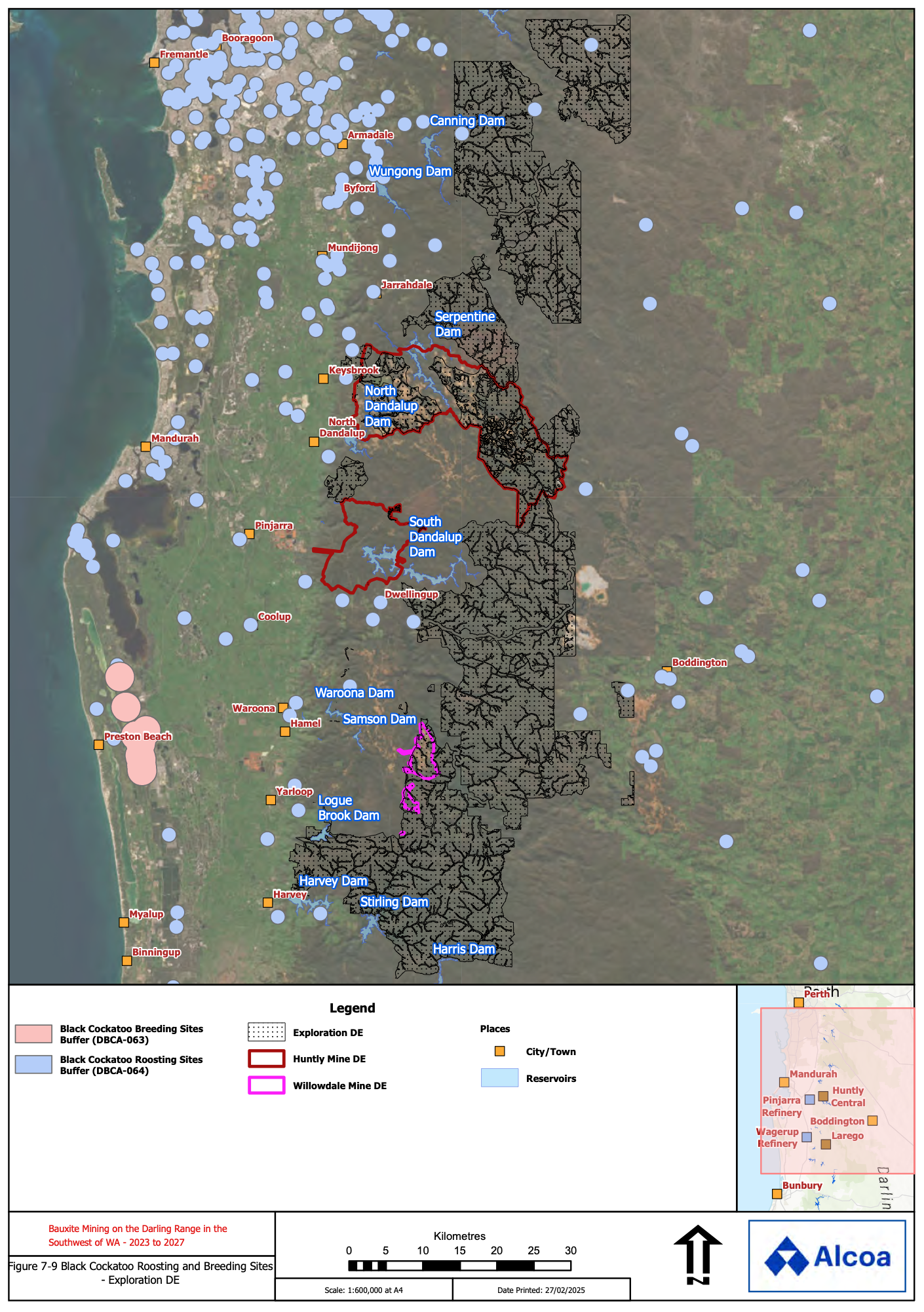
In late 2023, the Cook Government approved Alcoa’s 2023 to 2027 mining plan, which included permission to drill up to 105,000 holes a year into the jarrah forest in search of the best bauxite to mine. In the first eight months of 2025, 40,735 holes were drilled.
Alcoa told the EPA that it used drill rigs modified to minimise ground disturbance, drilling small holes less than 8cm in diameter and 6m deep, which were filled as soon as drilling finished.
While the miner calls this “low-impact forest drilling,” DMPE was not so sure. It questioned why Alcoa had provided no measurable evidence of minimal disturbance and natural recovery at the drill sites and along the drill rig’s path.
DMPE classified unfilled holes and filled holes that later subsided as a major risk to fauna, exacerbated by their huge number.
There is also a risk that paths created by the drilling rig make it easier for feral predators to access the forest. DMPE dismissed Alcoa’s proposal of increased monitoring of the animals as useless.
DMPE also noted that Alcoa had not considered the effect of vibration of the equipment on native animals and provided no details to back up its claim that noise would have no long-term effects on cockatoos. The regulator cautioned that the noise may be enough to make cockatoos abandon eggs or chicks in their nests and recommended that Alcoa halt drilling during the cockatoo breeding season over spring and summer.

Alcoa proposes to offset the environmental damage from strip mining up to 75 square kilometres of jarrah forest by having about three times that area of degraded jarrah forest elsewhere managed for at least 20 years.
However, DMPE had concerns about the plan, which would be financed by Alcoa paying a fixed amount per hectare of cleared forest for a third party to do the work.
For the offsets to be environmentally beneficial, the area must be in poor condition, but Alcoa’s submission to the EPA stated that most of the northern jarrah forest vegetation is intact.
Similarly, a 2025 report by the WA Biodiversity Science Institute, part-funded by Alcoa, concluded there was “a paucity of land available for offsets” in the northern jarrah forest.
“Alcoa needs to demonstrate that the chosen offset conservation areas are highly disturbed and degraded for the proposed offset to make sense,” the department wrote.
The Pittsburgh-based company committed to not mining the offset areas, but this is potentially “a null and void commitment” of no environmental benefit if Alcoa chooses land it was not going to mine anyway.
Also, while Alcoa has the exclusive right to mine bauxite in its vast lease, it cannot stop other companies from extracting other minerals from the forest.
Alcoa claimed work in the offset areas would benefit cockatoos within five years, but the department commented that the planned control of feral predators and installation of cockatoo drinking points were of no help against the gradual loss of tree hollows and breeding habitats.
Fowler said Alcoa was making exaggerated, unsupported claims about the environmental gains from its offset plans.
 Peter Milne
The mining regulator was also concerned that Alcoa’s Marri tree seedlings were dying more often, but the miner still assumed that later plantings to fill the gaps would have the higher historical survival rate.
The EPA is expected to publish its recommendations on Alcoa’s current mining and planned expansion by mid-2026. After a public comment period, Environment Minister Matthew Swinbourn will decide whether Alcoa can proceed, and, if so, under what conditions.
Boiling Cold has applied for an internal departmental review of DMPE’s decision to redact much of the document containing its comments on Alcoa’s mining plans.

No profit, falling production, inadequate maintenance, a safety plan in limbo and a big clean-up if exploration fails: challenges aplenty at the Canadian company's only offshore facility.
No profit, falling production, inadequate maintenance, a safety plan in limbo and a big clean-up if exploration fails: challenges aplenty at the Canadian company's only offshore facility.

The US miner illegally destroyed the habitat of endangered black cockatoos for six years.


Chief executive Bill Oplinger told Wall Street the miner had responded to all 60,000 comments on its WA expansion plans—in fact, it responded to fewer than 10, and some were unacceptable.
All the info and a bit of comment on WA energy, industry and climate every Friday